Understanding Application Needs Starts on the Factory Floor
In our own blending rooms and reactors, we see firsthand that resin choice shapes more than just the flow of production—it sets the upper limits for both process smoothness and final product consistency. Picking a Vinnol grade means looking beyond the glossy brochure numbers and focusing on the daily headaches and pain points faced in a plant: mixing time, filter changes, and unplanned downtime. As a staff that deals with real-world resin behavior every week, we're keenly aware how key properties—like viscosity, particle size, and copolymer composition—translate into real advantages or unwelcome bottlenecks. For example, picking a higher molecular weight grade may offer better scrub resistance in architectural coatings, but it can also overload mixers if the plant’s set-up isn’t adjusted accordingly. That reality gets overlooked when choices are left to marketing documents rather than collaborative talks between customers and engineers who run the reactors. Years of adjustments and hundreds of trial batches have taught us to weigh both the needs of the end user and the realities of what a production floor can manage.
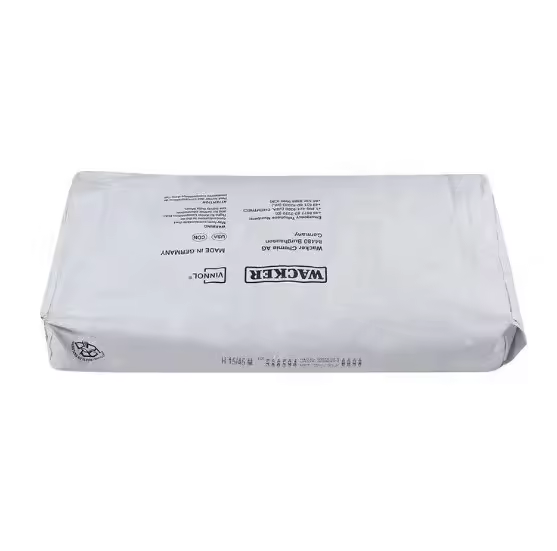
Why Production Realities Drive Resin Selection
Anyone who’s had to dump a half-batch because the resin wouldn’t dissolve knows that datasheets only tell part of the story. It’s tempting to sort Vinnol grades by theoretical compatibility or ultimate film appearance, but the most successful formulations come from knowing how raw material quirks play out alongside machine parameters, ambient humidity, and the network of pipes that bring everything together. Choices around plasticizer tolerance, stabilization, and saponification value tend to separate labs that run stable shifts from those plagued by filter clogging and waste. Shifts in the balance of vinyl chloride and vinyl acetate, for example, directly impact adhesion to troublesome surfaces—something we check in our own daily controls, especially when a customer calls in about labels peeling in damp storage. The resins themselves might have similar names, yet the fine details in morphology can save money on solvent use by reducing viscosity, or eliminate rework by solving issues with pigment dispersion. We don’t just rely on theory—we listen closely to the feedback from shop-floor crew and pull samples ourselves when any new resin is trialed.
Matching Resin to Performance—Lessons Learned From End Users
Feedback comes in every form: a call from a coating specialist struggling with drying time, a batch log showing unexpected foaming, or a return shipment flagged by a packaging plant. Each of these leads us to review our own batch records and QC logs, connecting the fine points of Vinnol grade chemistry with the user’s need. Vinnol grades rich in vinyl acetate find praise for their adhesion and clarity in sensitive lamination work, especially where clarity can’t be sacrificed. For industrial applications where weatherability or chemical resistance must stand up, more highly stabilized grades that can tolerate aggressive plasticizer loads outlast quick fixes. We often run our own accelerated aging and migration tests, placing panels outdoors or stressing films under mechanical load, so we see the outcome well before the customer ships millions of units. Choosing a grade becomes part of an ongoing dialogue between manufacturer and formulator, not a single transaction, because practical formulation always reveals new things—like color response to UV or what happens as temperature cycles in warehouses during transit. Our job is to connect this feedback loop to steady improvements in resin design, not just respond to complaints.
Fine-Tuning Compatibility and Processing
Many years of compounding specialty vinyl resins taught us to get granular with formulation adjustments. Vinnol’s different copolymer compositions bring not just unique solubility profiles, but also variations in melting behavior and film formation. Those differences matter for every process relying on tight cycle times, whether the product runs on high-shear mixers or passes through continuous extrusion lines. Customers sometimes aim for low-migration films to meet tough food contact standards; in those cases, we draw on our own compliance audits and migration studies to recommend grades that give repeatable extraction values—the kind we can stand behind with full regulatory support. Meanwhile, for demanding ink or adhesive applications, the ability to add functional ingredients without destabilizing the base resin defines whether a batch gets approved or rejected. Our own learning curve has come from post-mortems and successes, not just following generic blending protocols. It’s about knowing which resins can take certain kinds of pigment or filler loading without gelling out or splitting during storage.
Supporting Sustainable Choices and Market Shifts
Requests for lower-VOC, more environmentally sound coatings and adhesives have increased sharply in recent years. With Vinnol resins, we address concerns not just at the compliance level, but through the day-to-day usability of grades that support alternate plasticizers or offer higher solids content without sacrificing ease of processing. By working directly with regulatory changes—such as evolving limits for REACH or food-contact suitability—we build in test capacity and anticipate bottlenecks before they appear. Real-world trials show that some grades process more easily in waterborne systems or offer reductions in solvent residuals. We collaborate with large customers to troubleshoot transition batches, providing formulations tailored to upcoming regulations or changes in supply chain raw materials. This partnership-based approach draws on more than paper qualifications—it leverages years of shared troubleshooting and real performance data.
Data-Driven Choices Deliver Reproducibility
Resin selection always comes down to more than checkbox attributes. It’s data gathered in production, backed up by field complaints, turned into updated formulations. Our own historical logs—tracking every resin batch, deviation, and adjustment—make the single biggest difference in making recommendations and supporting customers building new product lines. In our experience, grades that look identical on paper can generate far different results in reality. Resin settling rates, filter clogging tendency, or even the ease of cleaning reactors after production are just as important as paper properties. Each step in resin selection and formulation scales up from years of doing, not just theorizing. Physical trials, taking feedback from every shift, and building those lessons into grade selection, is the backbone that keeps customers coming back.
Website: www.china-pva.net
Whatsapp: 0086-15380400285
E-mail: sales2@china-pva.net